What Exactly is Middleware?
If the Route is the waiter and the Controller is the chef, then Middleware is everything that happens between the customer placing the order and the food hitting the pan.
It’s the security guard checking IDs at the door, the sanitizer cleaning the table, or the logger writing down what time the customer arrived.
In Express, middleware functions sit between the Request and the Response. They can look at the data coming in, change it, or even stop the request if something is wrong.
In fact, you have already been using middleware without knowing it. Remember this line from our previous posts?
app.use(express.json());That is a built-in middleware function. It intercepts the raw request, parses the JSON body, and attaches it to req.body so your controller can use it. Without it, your server wouldn't understand incoming data.
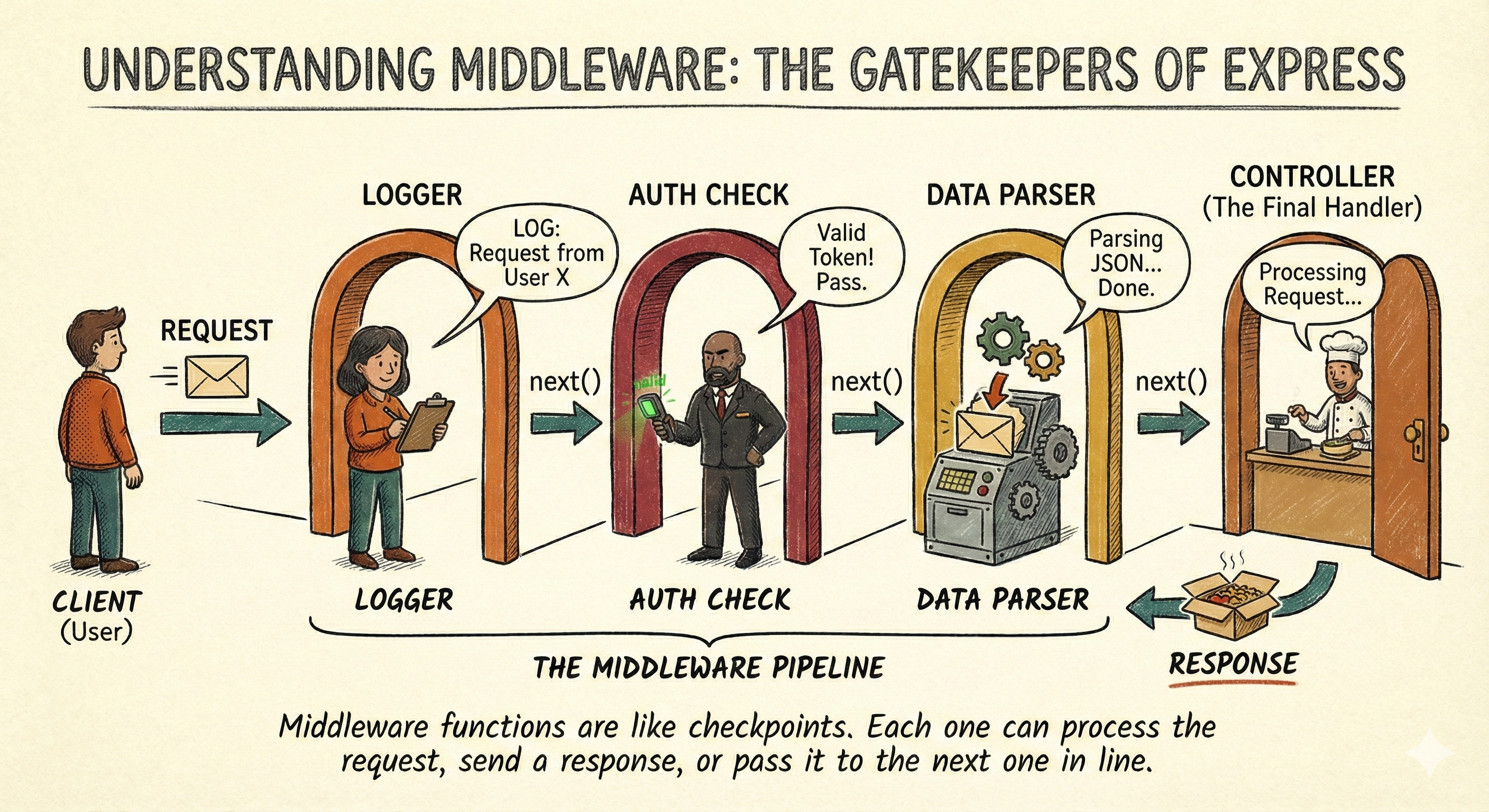
How Middleware Works
Middleware functions are just functions that have access to the req (request), res (response), and the next function.
The secret sauce is next(). If a middleware doesn't call next(), the request stays "hanging" forever. If it does, it passes the baton to the next person in line.
A Practical Example: The "API Key Checker"
Imagine you only want approved clients to access your POST /users route. Instead of adding an if statement to every single controller, we can create a single piece of middleware to act as the Bouncer.
Create: src/middlewares/auth.middleware.js
const apiKeyChecker = (req, res, next) => {
    // 1. Look for a custom header named 'x-api-key'
    const apiKey = req.headers['x-api-key'];

    // 2. If it's missing or wrong, STOP the request and send an error.
    if (!apiKey || apiKey !== 'super-secret-key-123') {
        return res.status(401).json({ message: 'Unauthorized: Invalid API Key' });
    }

    // 3. If the key is correct, pass the baton forward!
    next();
};

export { apiKeyChecker };
The Golden Rule of Middleware: Always Call next() (or respond)
Notice that we either return a res.status() or we call next()? This is crucial.
- If you call
next(): Express passes the request to the next function in the stack (your controller). - If you respond (
res.json): The cycle ends immediately, and the client gets the data (or error). - If you DO NEITHER: The request is left "hanging." The browser will spin forever until it times out.
Where You Place It Matters
Express executes middleware sequentially (top to bottom).
- Global Middleware: If you place
app.use(apiKeyChecker)before all your routes, it locks down your entire server. - Specific Route Middleware: You can inject it specifically into routes you want to protect.
Let's plug our Bouncer into just the user creation route!
Update: src/routes/user.routes.js
import express from 'express';
import { getUsers, createUser, deleteUser } from '../controllers/user.controller.js';
import { apiKeyChecker } from '../middlewares/auth.middleware.js';

const router = express.Router();

// Public route - anyone can view users
router.get('/', getUsers);

// Protected route - only someone with the API Key can create a user!
router.post('/', apiKeyChecker, createUser);

// Public route (for now)
router.delete('/:id', deleteUser);

export default router;
With just one word (apiKeyChecker), we’ve secured the route. If someone makes a POST request to /users without the x-api-key header, our middleware will instantly reject it. The createUser controller doesn't even have to worry about security!
Testing Our Bouncer in Action
Now that our apiKeyChecker is guarding the POST /users route, let's prove it works. You can test this using API clients like Postman, Thunder Client (a great VS Code extension), or even a simple cURL command in your terminal.
1. The Denied Request (Testing the Failure)
First, try to create a user without providing the API key. Send a standard POST request to http://localhost:3000/users (assuming your server is on port 3000) with your usual JSON body.
The Result:
You should immediately get a 401 Unauthorized status code with the JSON response we defined:
{
  "message": "Unauthorized: Invalid API Key"
}
The request never even made it to the createUser controller! Our middleware stopped it at the door.
2. The Approved Request (Testing the Success)
Now, let's act like an approved client. We need to attach our secret key to the request headers.
If you are using Postman or Thunder Client:
- Go to the Headers tab for your request.
- Add a new key:
x-api-key. - Set the value to:
super-secret-key-123.
If you prefer the terminal, your cURL command would look something like this:
curl -X POST http://localhost:3000/users \
     -H "x-api-key: super-secret-key-123" \
     -H "Content-Type: application/json" \
     -d '{"name": "Test User", "email": "[email protected]"}'
The Result:
This time, the middleware finds the correct header, runs the next() function, and passes the baton forward. You should see a 200 OK or 201 Created response from your actual createUser controller, confirming that the data was processed successfully.
Summary
Seeing that 401 Unauthorized in action proves just how powerful middleware is in Express. It lets you run logic on requests—like our Bouncer stopping unauthenticated users at the door—without polluting your controllers or touching your core business logic.
With a single function, you can plug behavior directly into the request lifecycle. That same pattern powers real-world features:
- Security to validate tokens, passwords, and permissions.
- Validation to stop bad data early.
- Logging to track traffic.
And at the core of it all is one rule: either send a response, or pass control forward with next().
But middleware doesn’t solve everything.
Take a look at most Express controllers. They’re packed with repetitive try-catch blocks just to keep the server from crashing when interacting with a database. Miss one, and an unhandled error can take your app down.
That’s not scalable, and it’s not clean.
In the next post, The Art of Clean Error Handling: Global Async Wrappers & Consistent Responses, we’ll use what we learned about middleware and higher-order functions to wrap our controllers. We'll eliminate those messy try-catch blocks entirely and introduce a standardized Error class so your API responses become predictable, consistent, and professional.
Happy coding!